Read a 1662 letter opening
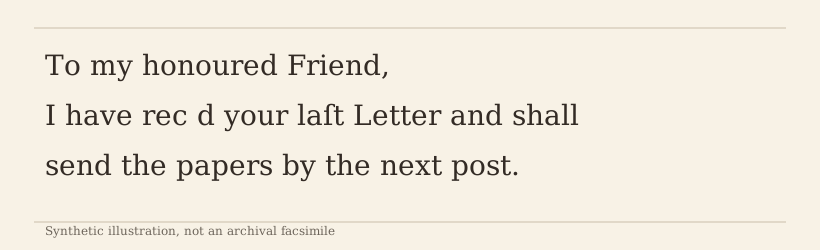
Read a denser synthetic 17th-century-style letter opening. Keep abbreviations visible and mark any uncertain expansion.
Reveal the reviewed diplomatic transcript
To my honoured Friend, I have rec d your laſt Letter and shall send the papers by the next post.
Square brackets mark an uncertain reading; the transcript is not silently normalised to modern spelling.
Provenance: Synthetic teaching sample created for handwritinganalysis.ca. This is not a dated archival document or a facsimile of a historical hand.
Save your private reading
Record the parts you are unsure about and what you would change after checking the reviewed transcript. This stays in your browser.
Further reading: Library of Congress paleography guide · 18th-century British-American writing. Do not reproduce the DoHistory images or exercise text without permission.