Read a 1749 receipt line
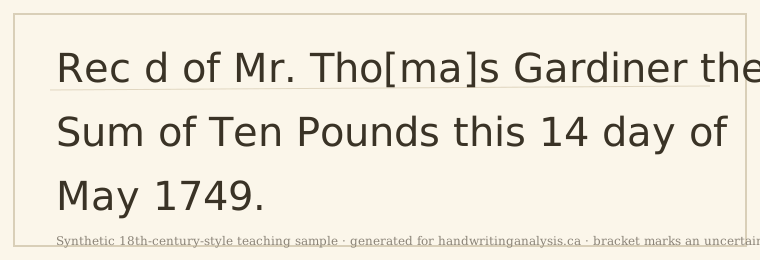
Read the synthetic 18th-century-style receipt line. Use the hints about letterforms and abbreviations, then compare your reading with the reviewed diplomatic transcript. Brackets mark uncertain readings.
Reveal the reviewed diplomatic transcript
Rec d of Mr. Tho[ma]s Gardiner the Sum of Ten Pounds this 14 day of May 1749.
Square brackets mark an uncertain reading; the transcript is not silently normalised to modern spelling.
Provenance: This sample is a synthetic teaching line generated for handwritinganalysis.ca. It is not a real historical document and must be replaced by a licensed or public-domain original before any claim to be a verified 18th-century sample.
Save your private reading
Record the parts you are unsure about and what you would change after checking the reviewed transcript. This stays in your browser.
Further reading: Library of Congress paleography guide · 18th-century British-American writing. Do not reproduce the DoHistory images or exercise text without permission.